
Free Backgammon Practice Lessons
Practise backgammon with six free interactive lessons: opening moves, hitting, bar entry, doubles and bearing off. Get hints and check each turn.
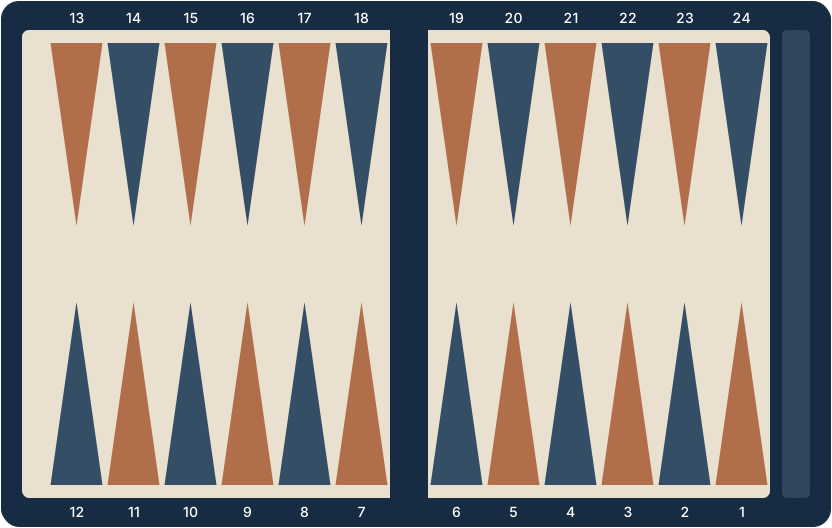
You play Ivory. The lesson supplies the dice: drag a checker, click its source and destination, or use the accessible move controls. Use every playable die, then select Check lesson.
Choose a lesson
Make your 5-point
Play the opening 3–1 to put two Ivory checkers on point 5. Use both dice, then check the lesson.
Move one checker from 8 to 5 with the 3, then one from 6 to 5 with the 1.
Navy
0 points
You
0 points
Practice the opening 3–1
Make point 5 with 8/5 and 6/5. The dice are fixed for this lesson.
Accessible move controls
Tab into the board, use the arrow keys to choose a point, press Enter to select it, then choose a legal destination. Escape clears the selection. You can also use these fields.
Board as text
How these practice games work
Each position isolates one skill. The same rules engine used in full games checks bar priority, open points, dice use and bearing off. A legal turn is checked against the stated lesson goal; a different legal turn is not labelled a strategic blunder. Reset lets you try again, and the hint explains an example without making a move for you.
These are fixed teaching positions, not random full games or expert move analysis. They do not alter your current match, record a win, save lesson progress or assign a rating. The computer opponent does not move during an exercise. Your practice choices stay on this page.
Six beginner exercises with worked answers
1. Make your 5-point
Play the opening 3–1 to put two Ivory checkers on point 5. Use both dice, then check the lesson.
Read the worked answer
Move one checker from 8 to 5 with the 3, then one from 6 to 5 with the 1.
8/5 6/5 makes a protected home-board point. The 3 and 1 are two separate moves; they do not have to move the same checker.
2. Hit and cover a blot
Hit Navy’s lone checker on point 5 and leave two Ivory checkers there. Use 3–1.
Read the worked answer
Play 8/5 with the 3 to hit, then 6/5 with the 1 to cover.
The hit sends Navy to the bar; covering point 5 protects the checker that hit. In a real game, check the whole position before deciding whether a hit is worth the risk.
3. Enter from the bar first
Bring Ivory’s hit checker back from the bar, then move it onward to point 22. Point 24 is blocked.
Read the worked answer
Enter on 23 with the 2, then move 23/22 with the 1.
A checker on the bar takes priority over every other checker. Point 24 has two Navy checkers, so the 1 cannot enter there; the 2 enters on 23.
4. Use all four double moves
Use all four 2s from the starting position. Any complete legal turn passes this lesson.
Read the worked answer
One example is to move two checkers 6/4 and two checkers 13/11, each using a 2.
Double 2 is four moves of two points. There are several valid turns; this exercise checks that all four available moves are used, not that you found a single “best” play.
5. Use the higher die when only one fits
Bear off Ivory’s final checker from point 4 with a roll of 6–5. Only one die can be used.
Read the worked answer
Use the 6 to bear off from point 4. There are no Ivory checkers on higher points.
Either number could remove the final checker, but both cannot be used. The higher-die rule requires the 6. An oversized die can bear off from the highest occupied point.
6. Finish bearing off
Bear off both remaining Ivory checkers with 6–4. All your checkers are already home.
Read the worked answer
Use the 6 to bear off from 6 and the 4 to bear off from 4; either order works.
Exact dice remove checkers from their matching points. Moving inside the home board can be legal, but here removing both checkers completes the goal immediately.
Take the lesson into a full game
When a rule is unclear, use the illustrated backgammon rules guide. For choosing between legal moves, read beginner backgammon strategy. Then play a casual computer game or invite a friend. Undo lets you reconsider an unconfirmed move; a confirmed turn is final.