What is backgammon?
Backgammon is a board game for two players. Each player has 15 checkers that move around 24 points according to two dice, and the first player to bring every checker home and bear it off wins. Luck decides the numbers; your choices decide what they are worth. You can learn to play backgammon free here and practise each rule straight away in a free backgammon game against the computer.
Set up the board
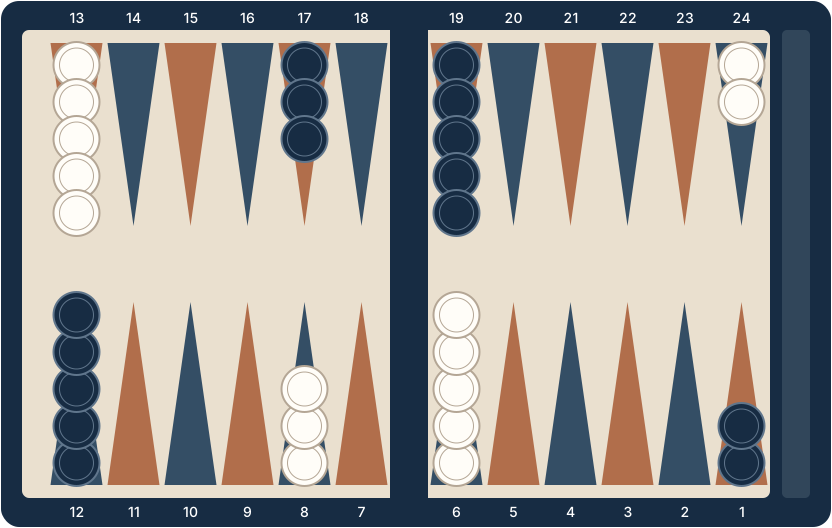
Each player has 15 checkers. From your own perspective, put two on point 24, five on point 13, three on point 8 and five on point 6. Your opponent uses the mirrored arrangement.
Start with the opening roll
Each player rolls one die. If they tie, roll again. The player with the higher number moves first using both numbers from that opening roll.
Move with both dice
Each die is a separate move. A 3 and a 1 can move two checkers, or one checker through two legal stops. Doubles give four moves of that number. Use as many dice as legally possible. If only one die can be used and either is playable, use the higher number.


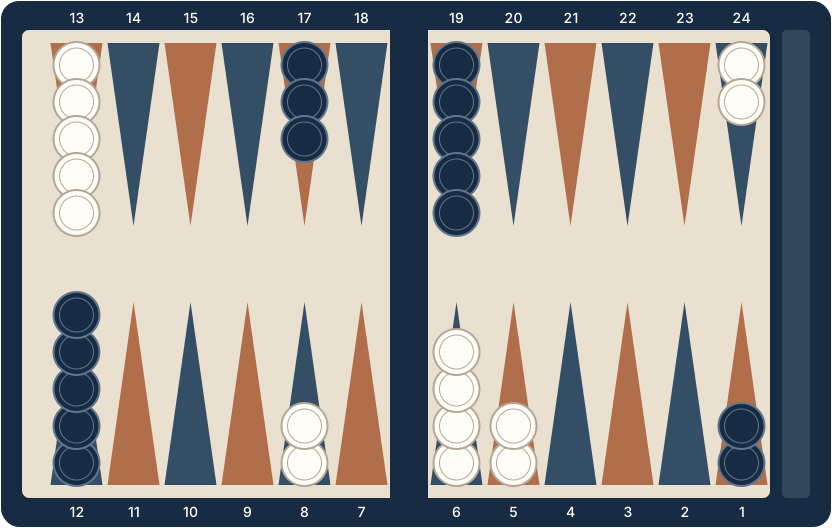
Opening 3–1
8/5, then 6/5 makes point 5.
Hit a blot and enter from the bar
A point with one opposing checker is a blot. Landing on it sends that checker to the bar. A player with a checker on the bar must enter it before moving any other checker. Points occupied by two or more opposing checkers are closed.
Ivory enters on Navy’s home board, so a 2 enters on point 23. Navy enters on Ivory’s home board, so a 2 enters on point 2. If both numbers land on closed points, the turn passes.
Bring every checker home
Ivory’s home board is points 1–6. Navy’s home board is the opposite quadrant. Once all your remaining checkers are home, you can begin bearing off.
Bear off your checkers
An exact die removes a checker from that point. An oversized die can remove a checker from your highest occupied point only when no checker remains on a higher point. Internal home-board moves are also possible, subject to using the maximum number of dice.
Understand the score
A normal win scores the current cube value. If the loser has borne off no checkers, a gammon scores twice that value. If the loser also has a checker on the bar or in the winner’s home board, a backgammon scores three times the value.
Use the doubling cube
Before rolling, the player who may offer the cube can propose doubling the game value. Taking accepts the new value and gives the taker control of the cube. Dropping ends the game at its previous value. In a one-point match, the cube is not used.
Learn the Crawford rule
The first game after either player reaches one point short of the match target is played without doubling. Only that game is the Crawford game. If the match continues, the cube is available again.
Build better habits
Look at the whole board before moving. A pair of checkers protects a point; a lone checker can be hit. Compare the risk of leaving a blot with the value of making progress. A simple plan helps, but no plan guarantees a win.
Want these backgammon instructions on paper? Download the free printable backgammon rules. Ready to try them? Invite a friend to a private room or play the computer.